Case study · Live · 2025
Toritype
Speech-to-text that understands Nigerian English and Pidgin
Role
- Frontend Engineering
- UI & Product Design
- Backend & Model Deployment
Built with
- Next.js 15
- React 19
- Tailwind CSS
- FastAPI
- MongoDB Atlas
- Whisper + LoRA
- Hugging Face Spaces
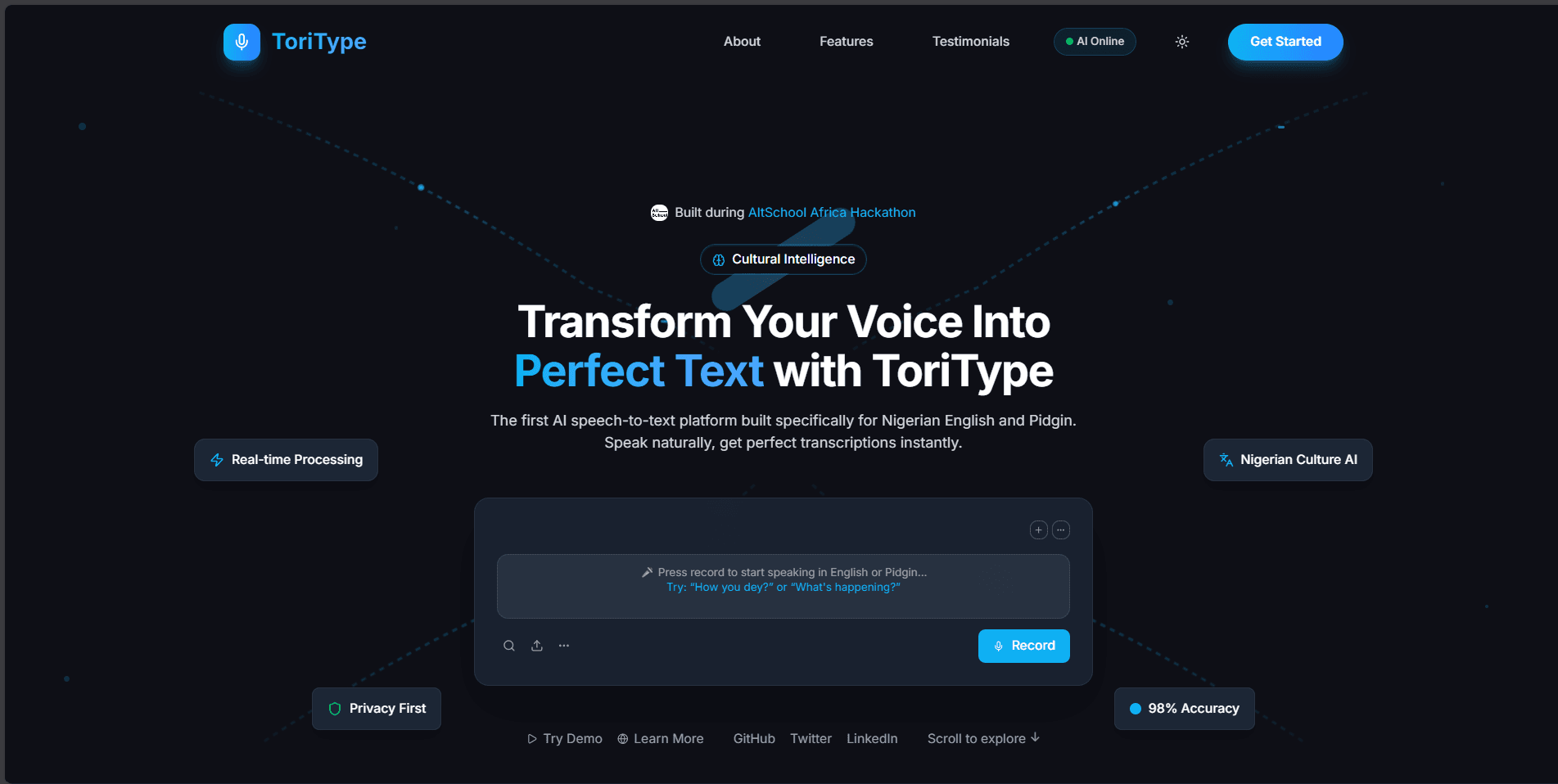
Most speech-to-text models are trained on Western accents and phrasing. Point them at Nigerian English or Pidgin and the errors pile up fast, until the tool is useless for the people who need it most. Toritype was our answer, and it won the AltSchool hackathon.
- Winner
- AltSchool hackathon
- Live
- shipped and online
- Whisper
- fine-tuned with LoRA
01
Context
Creators, businesses, and transcribers across Nigeria speak Nigerian English and Pidgin every day. Global transcription tools treat that speech as noise, and the errors make the output useless for real work.
02
The Problem
The models were never trained on how we talk. Worse, the ones that come close try to correct Pidgin into standard English, which strips out the meaning and the culture along with it.
We had an AltSchool hackathon's worth of time to prove a different approach could work.
03
The Approach
We fine-tuned Whisper with LoRA on local speech so the model learns Nigerian English and Pidgin instead of guessing at them, then added Pidgin-aware post-processing that preserves the way people actually speak rather than flattening it.
04
Design & Frontend
This is where I spent most of my time. I designed and built the dashboard: record straight from the browser or upload a file, then watch the transcript come back and work with it without fighting the interface.
It is responsive throughout, because the people most likely to need this are on their phones. I kept the interface quiet so the transcript is the thing you notice.
05
Architecture
We split the system into three deliberate pieces: a Next.js frontend on Vercel, a FastAPI service with MongoDB Atlas on Render, and the ML inference running as its own FastAPI service on Hugging Face Spaces.
Keeping inference separate mattered. The model is the heavy, slow, expensive part, so giving it its own service meant it could scale on its own without dragging the rest of the app down with it.
06
How It Flows
The browser records or uploads audio. The frontend calls the API's transcribe endpoint. The API forwards the file to the Hugging Face Space, and what comes back is post-processed and stored in MongoDB, so the transcript is still there when you return.
07
My Role
I owned the frontend, designing the interface and building it, and I worked on the backend and on getting the model deployed and talking to the rest of the system. Under hackathon time pressure, deployment is usually where projects die, so that part mattered as much as the code did.
08
Where It Stands
It won the hackathon, and it is still live and online. What started as a build under real time pressure is a working product you can use today.
09
Lessons
Building for people the big models ignore is a product decision before it is a technical one. The interesting work was not only fine-tuning the model, it was deciding that preserving Pidgin was a feature rather than an error to be corrected.